
Cyrus the Great Day: How to Tell Your Kids About Cyrus
October 29, Cyrus the Great Day, is a reason to remember our roots. Learn who Cyrus was, what his cylinder says, which popular stories are myths, and how to make the day meaningful for your kids.
Written by: Mahroo Mahdavi
Number of Views: 157
Reading time: 6 min
It is an autumn evening. An Iranian family is sitting around the dinner table in Toronto. Their nine-year-old son, who has been learning about the history of Greece and Rome at school, suddenly asks, “Mom, who was Cyrus? My friend says he was a famous Persian king.”
His mother smiles, but for a few seconds, she isn’t sure where to begin. Should she tell him about Pasargadae? The cylinder kept at the British Museum? Or the feeling that comes alive in her heart every time she hears his name?
For many of us living far from home, Aban 7 (October 29), Cyrus the Great Day, is more than just a date on the calendar. It is an opportunity to remember where we come from and what we want to pass on to our children. In this article, we’ll explore who Cyrus the Great was, what his famous cylinder actually says, which stories about him are myths, and how we can explain the significance of this day to our children in simple, engaging language.
Why Is Aban 7 Celebrated as Cyrus the Great Day?
Cyrus the Great Day is associated with Cyrus’s entry into the city of Babylon in the autumn of 539 BCE. According to a Babylonian tablet known as the Nabonidus Chronicle, Cyrus entered Babylon on the third day of the Babylonian month of Arahsamnu. Researchers have identified this date as October 29, which corresponds approximately to Aban 7 on the Iranian calendar.
What makes this event special is the way Cyrus entered the city. According to Babylonian sources, Babylon was taken without a battle or widespread destruction, and Cyrus treated the city’s people and their beliefs with respect.
Cyrus the Great Day is neither an official holiday nor a formal national observance. People themselves, both in Iran and among Iranian communities around the world, have kept this day alive as a tradition. Perhaps its grassroots nature is part of what makes it so meaningful to many of us.
This year, Aban 7, 1405, falls on Thursday, October 29, 2026.
If you’d like your children to learn more about the traditions and celebrations of ancient Persia, you can also explore our article on Mehregan, the ancient Persian festival, and its traditions, a celebration with deep historical roots and associations with friendship, kindness, and gratitude.
Who Was Cyrus the Great?
Cyrus II, known as Cyrus the Great or Cyrus the Magnificent, was the founder of the Achaemenid Empire. He was born around 2,500 years ago, in the sixth century BCE, in the land of Persia (modern-day Fars Province in Iran), and died around 530 BCE.
Over approximately three decades, Cyrus brought vast territories under his rule, stretching from Asia Minor to Central Asia and Mesopotamia. But what made his name endure was not simply the size of his empire. His treatment of different peoples earned him praise even from writers outside Persia:
Xenophon, a Greek writer, wrote a book called Cyropaedia, presenting Cyrus as a model of a wise ruler.
In the Bible (Old Testament), Cyrus is mentioned with respect because he allowed Jewish exiles in Babylon to return to their homeland and rebuild their temple.
Herodotus, a Greek historian, also recounted the story of Cyrus’s life in his work The Histories.
It is remarkable that the Greeks, who belonged to a civilization that would later become a political rival of Persia, also wrote favorably about Cyrus.
The Cyrus Cylinder Explained in Simple Terms
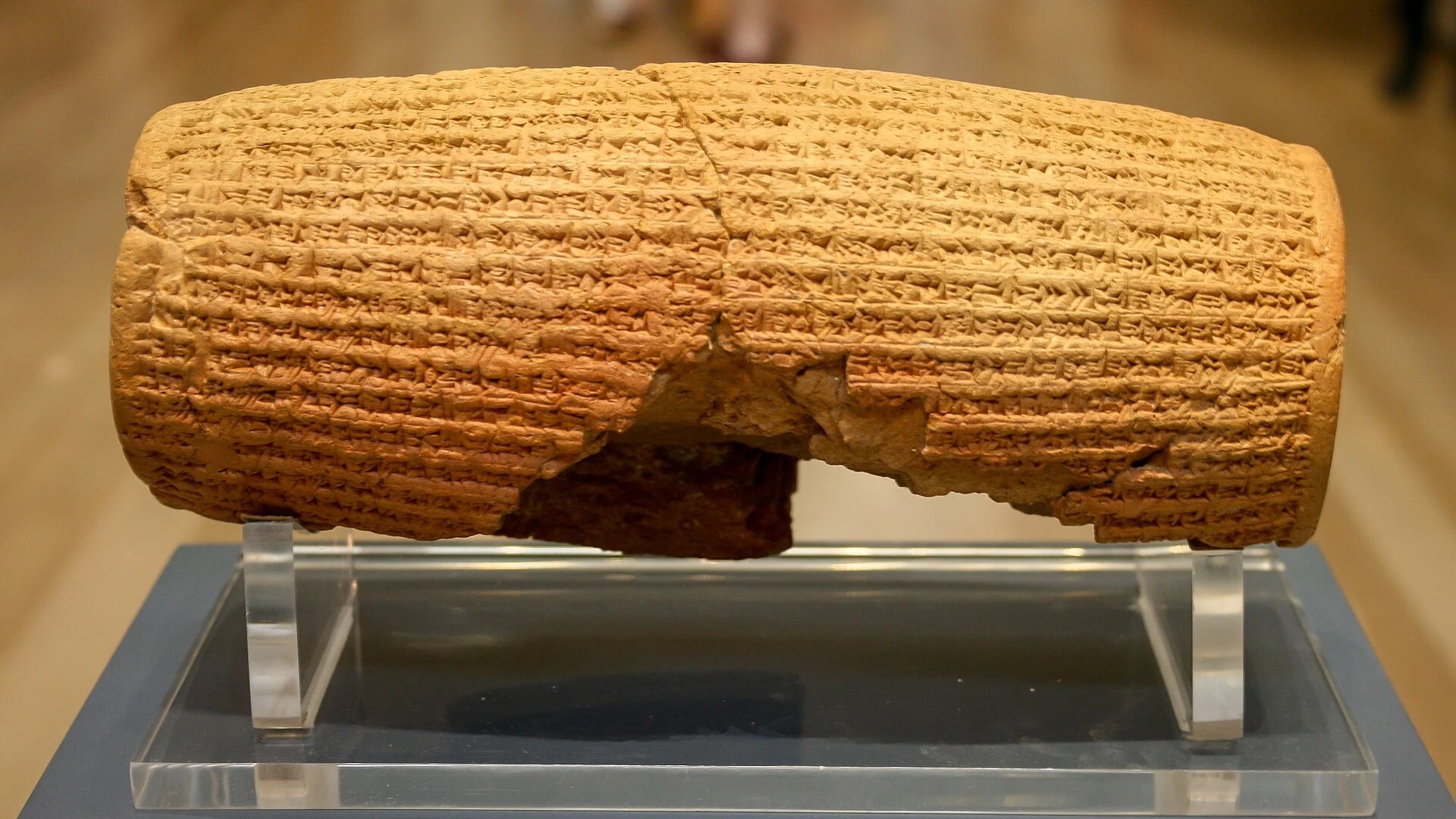
The Cyrus Cylinder is a clay cylinder measuring approximately 22 centimeters in length, a little longer than the span of a hand. It is inscribed in cuneiform script in Akkadian, the language used by the Babylonians. It was discovered in 1879 among the ruins of Babylon in modern-day Iraq and is now kept at the British Museum in London.
What is written on the cylinder?
In simple terms, its text covers the following points:
Cyrus introduces himself and his ancestors.
He describes how the previous ruler of Babylon mistreated the people and their religious traditions.
He states that he entered Babylon peacefully, without a battle.
He declares that he brought peace to the people of Babylon and eased their hardships.
He says that he returned displaced people and sacred statues belonging to various cities to their original homes and places.
The cylinder’s central message is respect for other people’s beliefs and the restoration of people to their homes. This is what makes its message meaningful even after 25 centuries, especially for those of us who understand what it means to live far from home.
A Few Interesting Facts
A replica of the Cyrus Cylinder has been displayed at the United Nations Headquarters in New York since 1971.
In 2013, the original cylinder traveled to the United States for an exhibition. It was displayed in cities including Washington, Houston, New York, San Francisco, and Los Angeles. Thousands of Iranian Americans lined up to see it.
In later years, two small fragments of another tablet containing similar text were also identified in the British Museum’s collection. This suggests that the text may have been written and circulated in several versions.
Pasargadae: Where Cyrus Rests
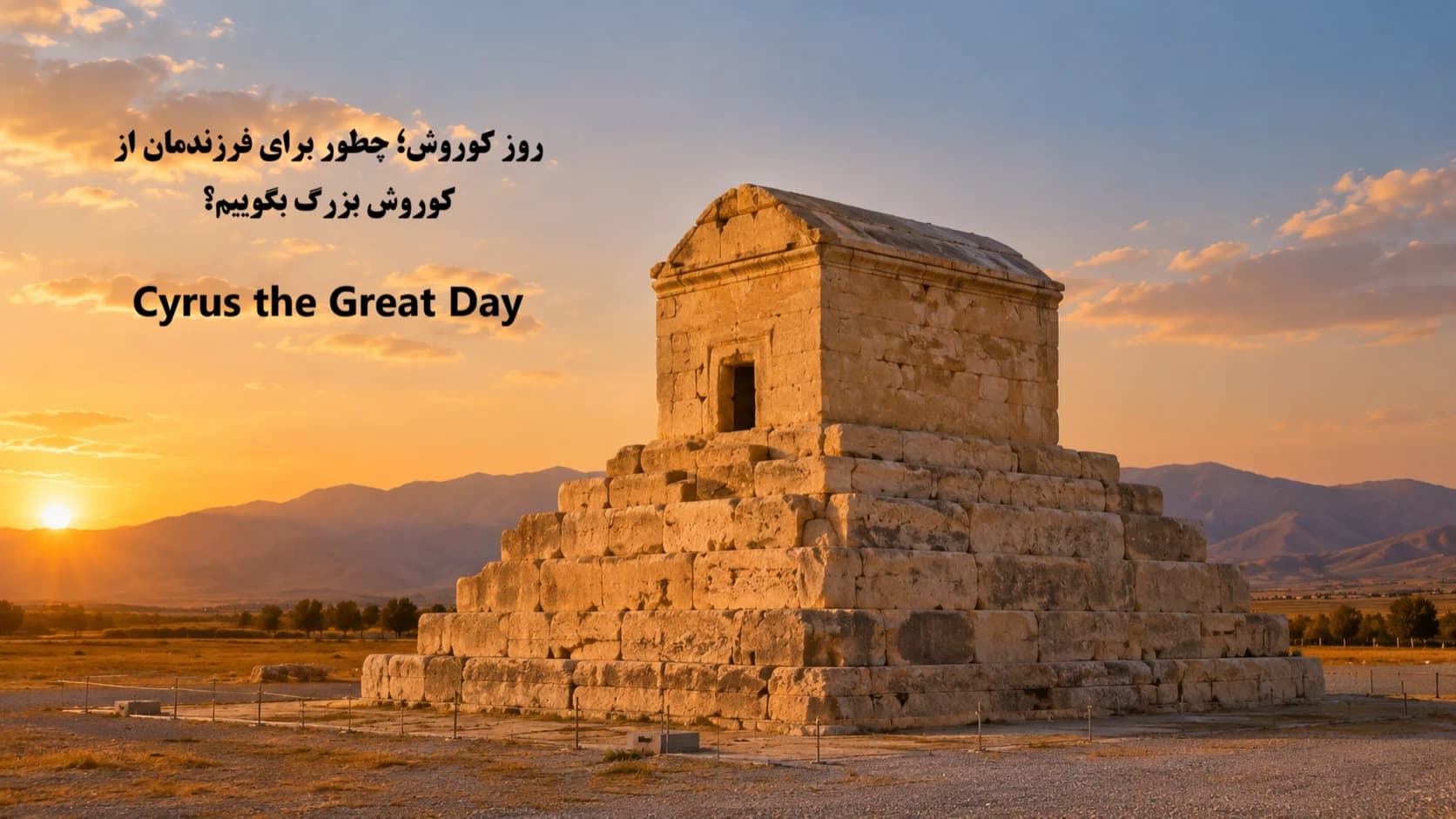
Pasargadae, in Fars Province, approximately 130 kilometers north of Shiraz, was the first capital of the Achaemenid Empire. It was built under Cyrus’s orders. His tomb stands on this plain as a simple yet impressive structure made of large stone blocks: a small chamber with a pitched roof resting on six stone steps.
The simplicity of the tomb may be the first thing that surprises visitors. The ruler of one of the largest empires of the ancient world rests in a structure with neither gold decorations nor towering columns.
Pasargadae was added to the UNESCO World Heritage List in 2004. Alongside the tomb, the site contains the remains of palaces and a garden considered one of the earliest examples of the traditional Persian garden.
The Story of Alexander and Cyrus’s Tomb
Greek historians recorded that when Alexander the Great arrived at Pasargadae, roughly two centuries after Cyrus, he found the tomb had been looted. Upset by what he saw, Alexander reportedly ordered its restoration.
Plutarch, a Greek writer, recorded that an inscription on the tomb carried a message along these lines:
“O man, I am Cyrus, who founded an empire for the Persians. Do not begrudge me this little earth that covers my body.”
Today, visitors cannot see this inscription on the tomb itself. It has survived only through this Greek account. Nevertheless, its message about the fleeting nature of power remains thought-provoking.
For many of us living far from Iran, Pasargadae is one of those places we hope to visit someday, taking our children by the hand so we can discover it together.
Fact or Myth? Common Beliefs About Cyrus the Great
Every year, as Aban 7 approaches, numerous quotes and stories attributed to Cyrus circulate on social media. Truly respecting Cyrus means talking about him accurately. So let’s take a look at a few common claims:
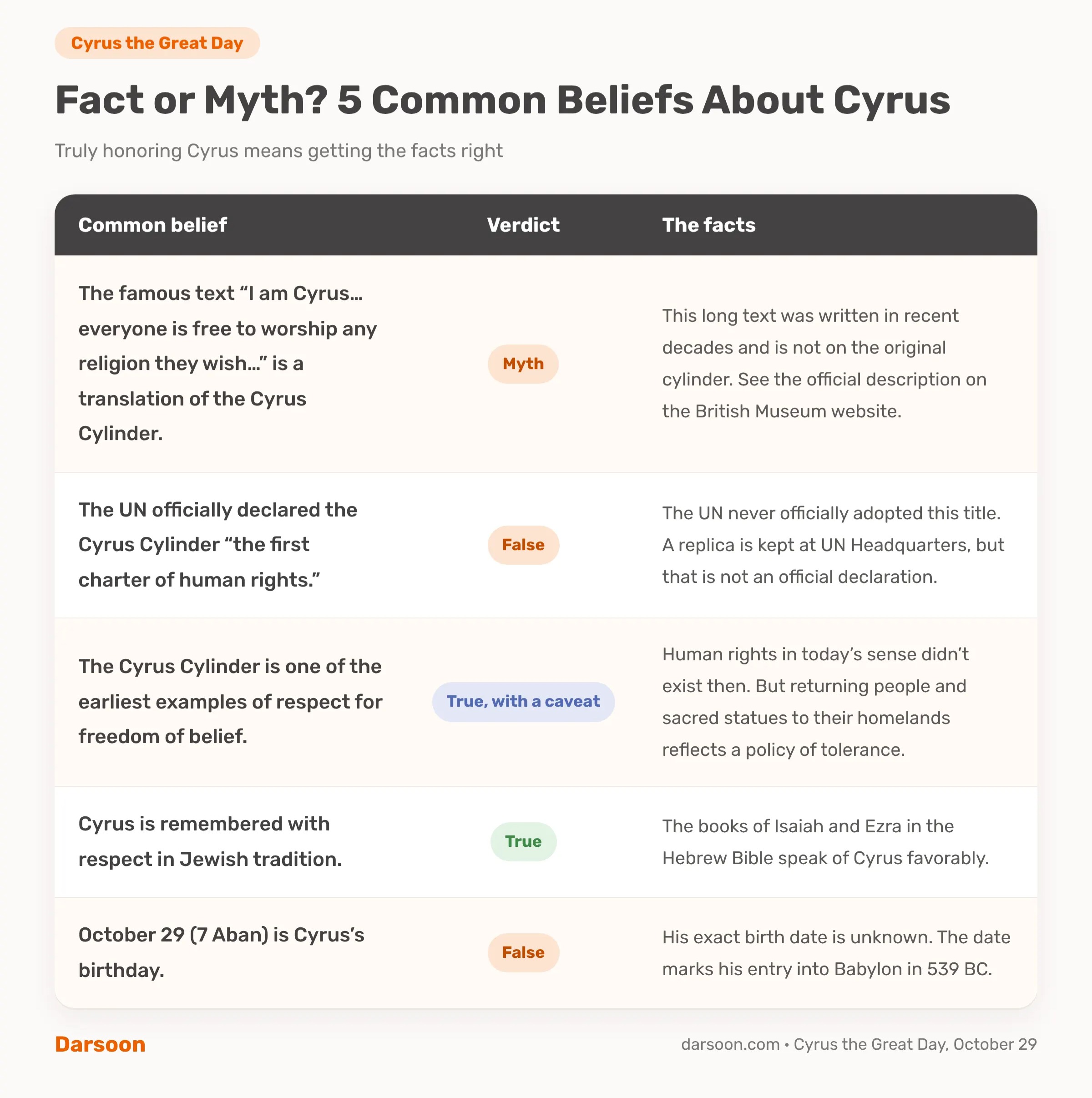
Understanding these differences does not diminish Cyrus’s achievements. On the contrary, it helps us speak about him with greater confidence when talking to our children and non-Iranian friends.
If you'd like to read the text itself, a scholarly English translation is available on Livius.org; parts of the cylinder are damaged, so it has gaps.
Cyrus the Great for Kids: How Can We Tell His Story?
Children don’t usually connect with dry historical facts, dates, and battles. They connect with stories. Here are a few simple ideas.
A Short Bedtime Story
“A very, very long time ago, even before your great-great-great-grandmother was born, there was a king in Persia named Cyrus. One day, he went to a big city called Babylon. The people there were sad because many of them had been taken away from their homes. Cyrus told them, ‘Anyone who misses their home can return. And everyone can freely pray to whichever god they believe in.’ The people were happy. Cyrus ordered these words to be written on a clay cylinder so everyone would know about them. And that cylinder still exists today, more than 2,500 years later!”
After telling the story, you can ask your child, “If you were Cyrus, what rule would you write?” This simple question can lead to a lovely conversation about kindness and respecting others.
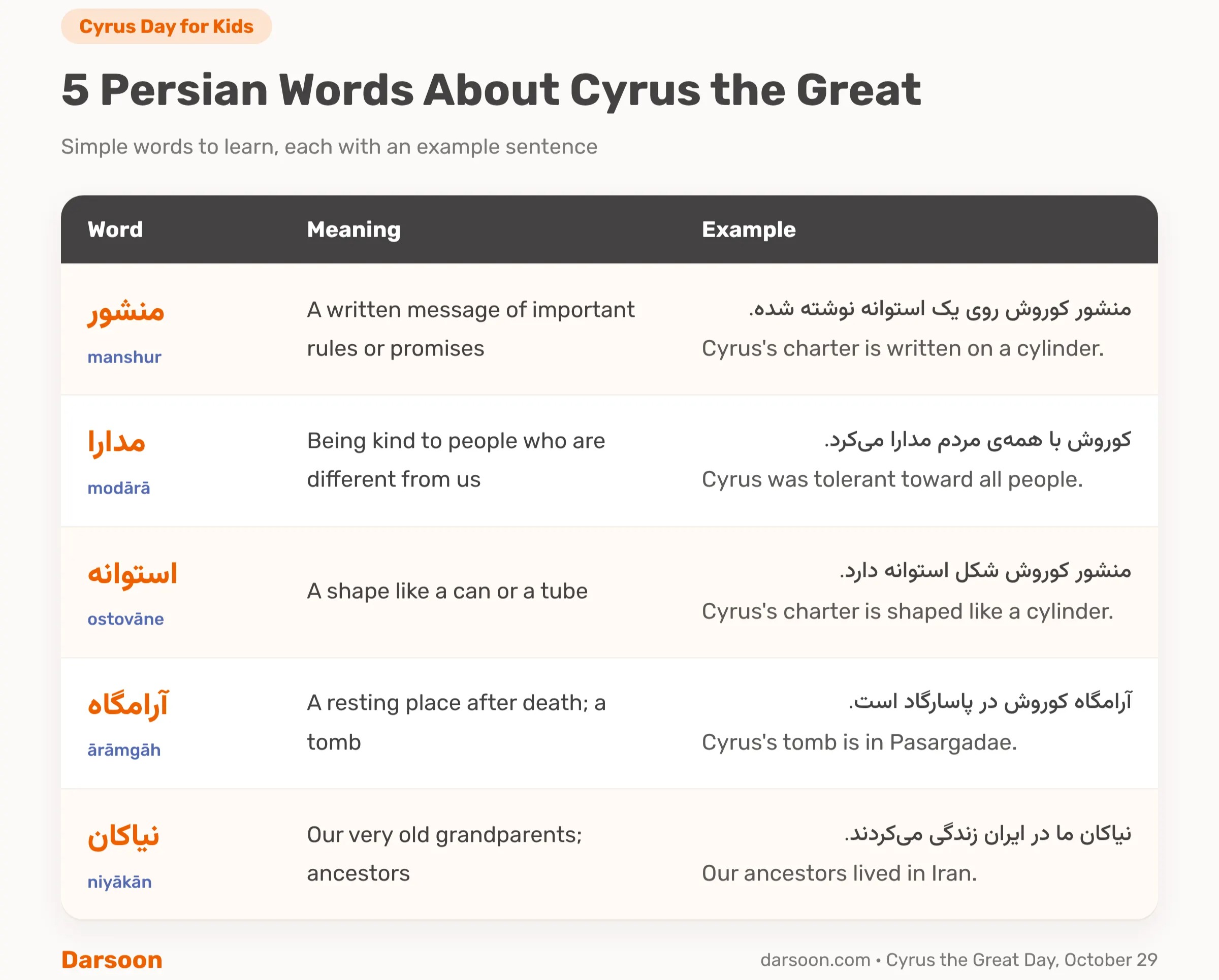
A Few Persian Words to Learn
Activities to Do at Home
Make a cylinder out of playdough: Shape a cylinder from playdough or clay, then let your child use a matchstick or toothpick to create their own version of “cuneiform writing.”
Draw the Tomb of Pasargadae: Six steps and a small chamber make this a simple and engaging drawing project for children.
Create a family charter: Write a “family charter” together, including three rules for being kind at home. If your child can write in Persian, encourage them to write it in Persian themselves.
Explore a map: Find Iran, Pasargadae, and Babylon (in present-day Iraq) on a map together.
How to Celebrate Cyrus the Great Day Away from Iran
You don’t need to plan a big event. Simply making this day visible in your home can create lasting memories for your children.
Have a family dinner: Prepare an Iranian dish and invite everyone at the table to share one thing they know about Cyrus or ancient Persia.
Read in Persian: Read a short story about Cyrus or ancient Persia aloud to your children in Persian.
See the cylinder in person: If you travel to London, seeing the original cylinder at the British Museum can be an unforgettable experience. In New York, you can also see a replica at the United Nations Headquarters, where visits may be possible through guided tours.
Call family in Iran: This day is a great opportunity for children to call their grandparents and ask what they heard about Cyrus when they were young.
Join Iranian community events: In cities with large Iranian communities, cultural associations often organize special programs.
Introduce Cyrus to non-Iranian friends: Children can give a short “Show and Tell” presentation about Cyrus and his cylinder in class. This can help build their confidence and give them an opportunity to take pride in their cultural heritage.

Final Thoughts: Language Is a Bridge to Our Roots
Twenty-five hundred years ago, Cyrus allowed people who had been separated from their homes to return. Today, many of us live far from home ourselves. We may not be able to return to Iran every day, but we can bring Iran into our new homes.
And nothing builds that bridge better than learning Persian. A child who knows Persian can hear the story of Cyrus from their grandmother, read the poetry of Ferdowsi and Hafez, and one day tell these stories to their own children.
If you would like your child to learn Persian in an enjoyable and structured way, Darsoon’s online Persian classes offer experienced online Persian tutors and learning plans tailored to each child’s age and level. Before booking and purchasing classes, you can also arrange a free introductory meeting with any teacher you choose to get to know their teaching style.
Happy Cyrus the Great Day to all Iranians, wherever in the world they may be!