
8-Week Math Kangaroo Prep Plan: A Week-by-Week Guide for Parents
Math Kangaroo takes place every March in Canada and the USA, and it is one of the best opportunities for children to build their problem-solving skills. This article walks you through a simple, structured 8-week prep plan, week by week. It moves from a first diagnostic test and topic-based practice to timed mock tests and a light review in the final days. We have also included test-day tips so your child walks into the exam calm and confident.
Written by: Mahroo Mahdavi
Number of Views: 107
Reading time: 5 min
The Math Kangaroo competition is the best-known elementary and middle school math competition in Canada and the United States, and it takes place every year in March. In 2027, the competition will be held in the United States on March 18, while in Canada, it is usually held later in the same month. This means that if you start in mid-January, you have exactly eight weeks to prepare.
Many parents either start too late or practice without a plan, giving their children a few random questions every evening. However, a short, structured plan with three 30–45-minute sessions per week usually produces better results without exhausting the child. In this article, we’ll go through an eight-week preparation plan, week by week, that you can start with your child today.
Before You Start: Get to Know the Math Kangaroo Test
In short, the Math Kangaroo test is multiple-choice, with questions arranged from easy to difficult. The test duration varies by grade.
For example, in Canada, students in Grades 1 and 2 answer 18 questions in 45 minutes, while students in Grade 5 and above answer 30 questions in 75 minutes. The important thing to remember is that Math Kangaroo focuses more on reasoning and creativity than memorizing formulas or calculating quickly.
To make the most of your eight weeks of preparation, it’s best to start in mid-January 2027. Keep in mind that the regular registration deadline in the United States is December 31, 2026, so it’s best to register first and then begin the practice plan. You can also get help with instruction and planning from a private online tutor math.
Your main practice resource should be questions from previous years, which are published on the official Math Kangaroo website. Registered students in the United States also have free access to video solutions.
The Week-by-Week Math Kangaroo Preparation Plan
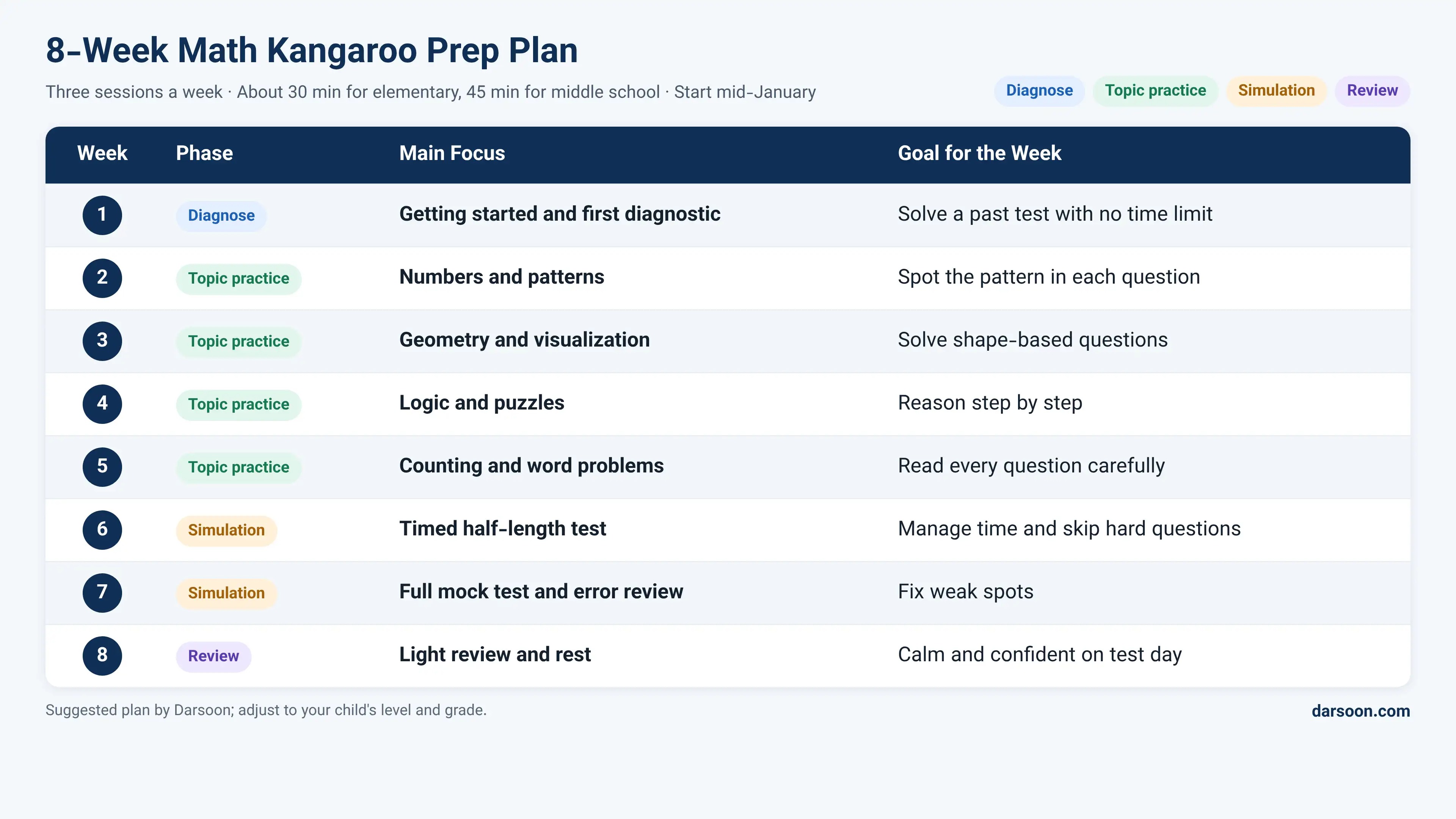
This plan is designed for three sessions per week. For elementary school children, around 30 minutes per session is enough, while middle school students can practice for about 45 minutes per session.
Week 1: Identify Your Child’s Starting Point
The goal of the first week is to understand where your child stands. In the first session, choose a complete test from the previous year that matches your child’s grade, and let them solve it calmly without a time limit.
In the second session, review the answers together and sort the incorrect ones into four categories: numbers and patterns, geometry, logic, and counting.
In the third session, have your child solve the incorrect questions again, this time with a little guidance from you.
By the end of this week, you should have two things: a list of two or three topics your child finds most challenging, and a regular schedule with set days and times for practice. When practice takes place at the same time on the same days each week, children usually adjust to the routine much more easily.
Week 2: Numbers and Patterns
A large part of Math Kangaroo involves identifying patterns. This week, focus on number sequences, even and odd numbers, the digits of a number, and number-placement puzzles. For older children, you can also add simple fractions and divisibility problems.
One of the best questions you can ask your child this week is, “How did you figure out that this was the next number?” Explaining a pattern helps children move beyond guessing and develop their reasoning skills.
Week 3: Geometry and Visual Thinking
Math Kangaroo geometry questions often involve counting squares and triangles in a figure, symmetry, paper folding, and viewing cubes from different angles.
This week, use simple household materials alongside practice questions. Fold and cut a piece of paper so your child can predict the shape that will appear when it is unfolded. Alternatively, build a structure with a few LEGO bricks and ask your child what it would look like from above. These hands-on activities can noticeably strengthen children’s ability to visualize shapes mentally.
Week 4: Logic and Puzzles
Math Kangaroo logic questions ask children to use several clues to reach a conclusion. For example, they might need to arrange people by height or determine which animal lives in which house.
This week, teach your child three strategies: drawing a table to organize clues, testing each option one by one, and working backward from the answer. Simple brain games, such as children’s Sudoku, can also make practice more enjoyable.
Week 5: Counting and Word Problems
This week, focus on problems that require counting the number of possible combinations, such as the different ways to put together an outfit or form three-digit numbers. The key strategy is to make an organized list of all possibilities so that none are missed.
The other half of the week should focus on word problems.
Create a short list of English math vocabulary with your child, including words and phrases such as more than, fewer, at least, each, and remaining. Misunderstanding these words can completely change the answer. Ask your child to underline the keywords in each question. This simple habit can prevent many careless mistakes.
Week 6: Getting Used to Time Pressure
So far, your child has been practicing without rushing. Now it’s time to introduce time limits. In two sessions this week, use half of a previous-year test and give your child half the actual test time. Place a clock or timer where they can see it.
During these sessions, practice the skill of moving on from a question. If a question takes too long, your child should mark it and move on to the next one.
Use the third session to practice filling out the answer sheet. For younger children, transferring answers correctly to the answer sheet is a skill in itself.
Week 7: Simulate the Full Competition
This week, administer a complete test under conditions that closely match the actual competition: in a quiet room, with the official time limit, using only a pencil and eraser, and without a calculator.
If possible, schedule the practice test for the same time of day as the actual competition.
In the next session, create a mistake notebook and classify each error into one of three categories: careless mistakes, running out of time, or not knowing how to solve the problem. This classification will help you decide what to focus on in the third session.
Week 8: Light Review and Staying Calm
Avoid introducing new material during the final week. Two short sessions with easy and medium-difficulty questions are enough to keep your child’s mind active and build confidence.
Take care of the practical details this week, too. Check the test center’s location and arrival time, and prepare a pencil and eraser.
Stop practicing entirely two days before the competition. A child who arrives with a calm mind and enough sleep will generally perform better than one who has been practicing until the night before.
Competition Day Tips and Common Mistakes
Competition day requires a plan just as much as the eight weeks leading up to it. Practice these tips with your child from the first few weeks so they become habits:
Start with the easy questions. Since the questions are arranged from easy to difficult, your child should answer the first questions carefully rather than waste time on a difficult one.
Skip difficult questions. If your child spends more than two or three minutes on a question, encourage them to mark it and return to it later.
Use the process of elimination. In many multiple-choice questions, eliminating two or three incorrect options makes it easier to find the right answer.
Draw diagrams for geometry questions. Sketching a simple figure on scratch paper can greatly reduce mistakes caused by visualizing shapes incorrectly.
Another common mistake among families is placing too much emphasis on the score. If children feel that everything depends on their results, they may become stressed and lose interest in math. In the United States, all Math Kangaroo participants receive a ribbon, a small gift, and a certificate of participation. Present the competition as an enjoyable experience for your child, not as an exam that will determine their future.

Preparing for Math Kangaroo with a Darsoon Online Math Tutor
Eight weeks is enough time to prepare well, provided the plan is consistent and your child enjoys solving problems. However, many parents don’t have the time or experience needed to choose appropriate questions and explain the solutions.
At Darsoon, our online math tutors prepare children for the Math Kangaroo competition through private lessons.
The tutor creates an eight-week plan tailored to your child’s grade and skill level, works through previous-year questions with them, and reviews mistakes step by step. You can start with a free introductory session, during which the tutor assesses your child’s level and helps you decide where to begin.
Math Kangaroo isn’t the only math competition taking place this season. If you’d like to explore which competition to consider next, read our guide to Math Competitions in USA & Canada in 2027: Guide for Iranian parents. The article covers dates, costs, and registration procedures for all the major competitions.