
Science Competitions for Students in Canada and the USA 2027: From Science Fairs to Olympiads
Science competitions are a great opportunity for children and teens who love experimenting and discovering how things work. They build scientific thinking and presentation skills, and they strengthen a student’s academic profile for university. This guide covers the most important science competitions in Canada and the USA for the 2026–2027 school year. It runs from ExploraVision for elementary students to the Canada-Wide Science Fair, Regeneron ISEF and the biology and chemistry olympiads, with dates, locations, fees, eligibility and how to register for each.
Written by: Mahroo Mahdavi
Number of Views: 45
Reading time: 5 min
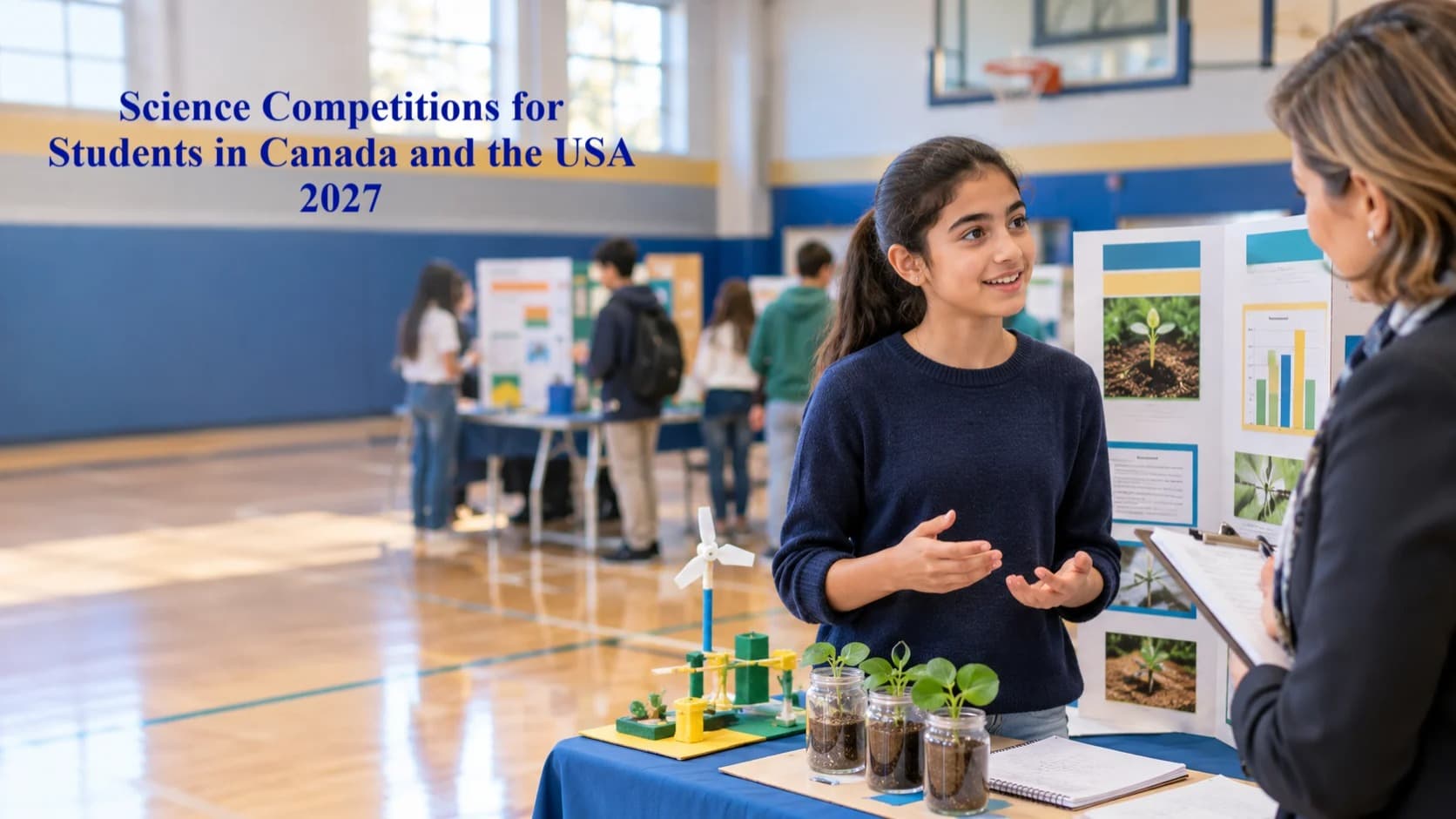
If your child is interested in science, experiments, and discovering how things work, science competitions in Canada and the United States offer an excellent opportunity. These competitions teach children to think like scientists, ask questions, and present their findings to others. In later years, they can also strengthen their academic résumés and support university applications.
However, the world of science competitions can be confusing for newcomer families. Some competitions are project-based and take months to complete, some are written exams, and others are only open to students through their schools or have specific residency requirements. In this guide, we introduce the most important science competitions in Canada and the United States for 2027, including their dates, locations, fees, eligibility requirements, and registration procedures.
Science Fair or Science Olympiad?
Science competitions fall into two main categories, and preparing for each requires a completely different approach.
Science Fair: Students design an actual research project, conduct experiments, and present their findings to judges. These competitions have multiple stages, starting at the school level, moving on to regional science fairs, and eventually reaching national or international levels. Winners from each stage advance to the next. It is best to start working on a project in the fall.
Science Olympiad and Science Exams: These are written exams or team competitions that assess students’ knowledge and problem-solving skills in a specific field, such as chemistry, physics, or biology. Practicing with past exam questions and developing a strong mathematics foundation are essential for these competitions.
Many successful students participate in both types, but the best starting point depends on the child’s age and interests.
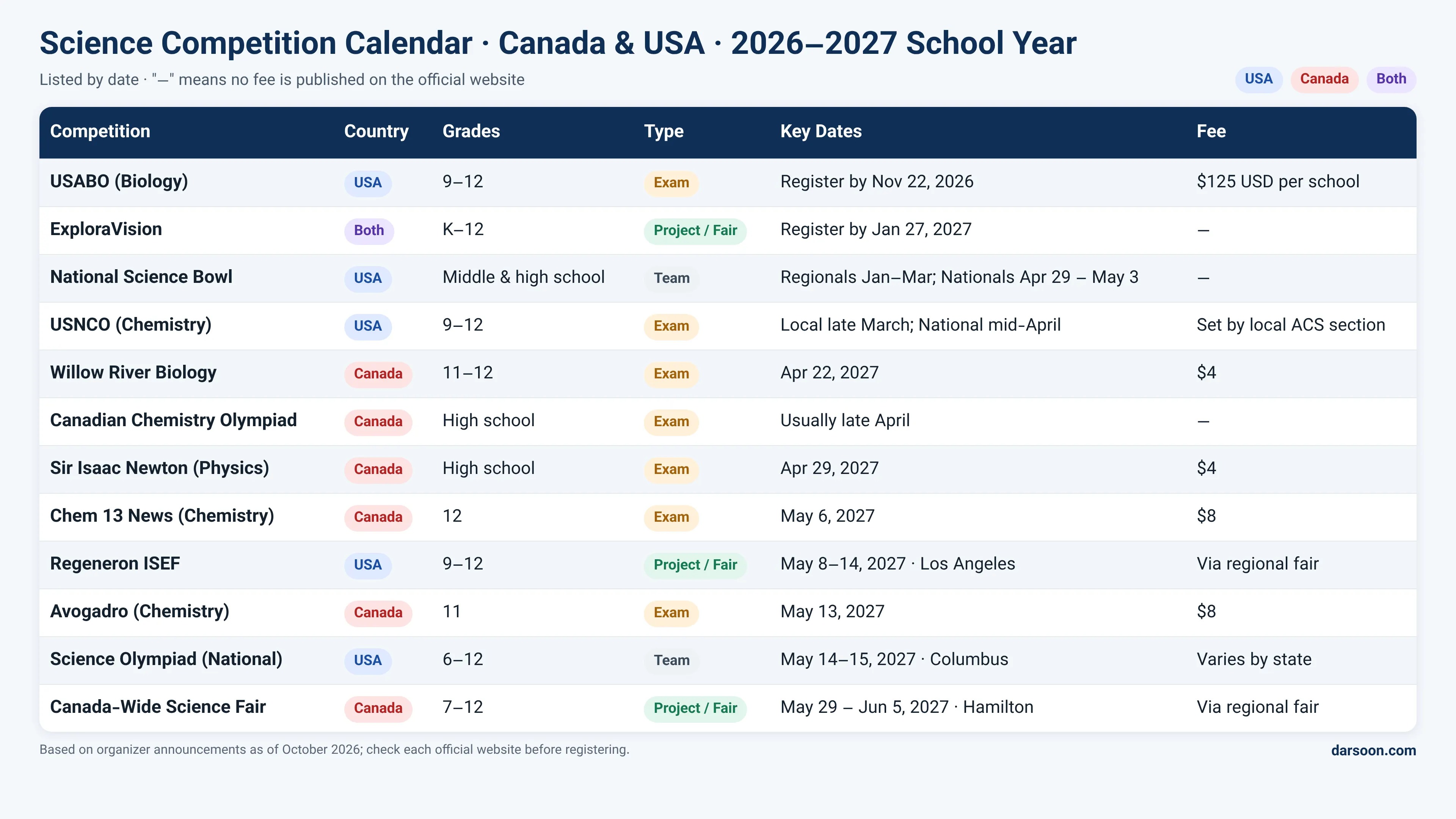
Science Competition Calendar for the 2026–2027 Academic Year
The following table presents the most important competitions in chronological order. Details about each competition are provided in the sections below.
For competitions with no fee listed, the official website has not announced a registration fee.
Science Competitions in Canada
Regional Science Fairs and the Canada-Wide Science Fair
Canada’s largest national science event for young people is the Canada-Wide Science Fair, which will take place from May 29 to June 5, 2027, in Hamilton, Ontario.
Students in Grades 7–12 first participate in their local regional science fair, which usually takes place in March or April. For example, the Greater Vancouver Regional Science Fair will be held from April 8 to 10, 2027, at the University of British Columbia (UBC).
Regional winners advance to the national competition, and top participants have the opportunity to join Team Canada at ISEF.
You can find your local science fair on the Youth Science Canada website.
University of Waterloo Science Contests
The University of Waterloo organizes several short, affordable science exams for high school students. Schools outside Canada can also participate.
These include:
Sir Isaac Newton Physics Contest: April 29 ($4)
Willow River Biology Contest: April 22, for Grades 11 and 12 ($4)
Chem 13 News Chemistry Contest: May 6, for Grade 12
Avogadro Chemistry Contest: May 13, for Grade 11
The two chemistry contests cost $8 each.
Registration for the University of Waterloo Science Contests is handled through schools, and the deadline is approximately two weeks before each exam.
Canadian Chemistry Olympiad and Brain Bee
The Canadian Chemistry Olympiad (CCO) is the pathway for selecting Canada’s national chemistry team. The exam is usually held in late April (in 2026, it took place on April 22), and students are registered by their chemistry teachers.
For high school students interested in medicine and neuroscience, there is also the Brain Bee. The competition begins at participating universities in different cities and then advances to the national level.
Science Competitions in the United States
Science Olympiad
Science Olympiad is the most well-known team science competition in the United States. It covers subjects such as biology, chemistry, astronomy, and engineering design.
Teams are formed through schools and compete in two divisions:
Division B: Middle school
Division C: High school
Regional and state competitions take place from February through April. The national competition will be held on May 14 and 15, 2027, at Ohio State University.
Team membership fees are determined separately by each state.
Regeneron ISEF and Thermo Fisher JIC
Regeneron ISEF is the world’s largest pre-college science fair. It will take place from May 8 to 14, 2027, in Los Angeles.
Students in Grades 9–12 can participate only by winning at a regional or state science fair affiliated with ISEF.
For middle school students, there is the Thermo Fisher Junior Innovators Challenge. The top 10% of students in Grades 6–8 at participating science fairs are nominated and complete a free online application.
In 2026, the application deadline was June 10.
National Science Bowl
The National Science Bowl is a fast-paced team-based science and mathematics quiz competition organized by the U.S. Department of Energy for middle and high school students.
Registration opens on October 5, 2026. Regional competitions take place from January through March, and the national finals will be held from April 29 to May 3, 2027.
Chemistry and Biology Olympiads
USABO (Biology): Open to students in Grades 9–12. The exam is administered online under school supervision. Schools must pay a flat fee of $125, and student registration remains open until November 22, 2026. Participants must be U.S. citizens or Green Card holders.
USNCO (Chemistry): Open to students in Grades 9–12. The local exam is usually held in late March or early April by local chapters of the American Chemical Society (ACS). Top students advance to the national exam in mid-April. Contact your local ACS chapter now to learn how to register.
ExploraVision
One of the few competitions open to students as early as kindergarten, and one in which students from both Canada and the United States can participate, is ExploraVision.
Teams of two to four students identify a real-world problem and design a technology that could solve it within the next 10 years.
The registration deadline is January 27, 2027. National winners receive a cash prize and a trip to Washington, D.C., in June 2027.
Which Competition Is Right for Which Age Group?
Elementary School: ExploraVision is an excellent choice. It encourages teamwork and introduces children to thinking about real-world problems. A school science fair is also a great starting point.
Middle School: Regional science fairs (and the Thermo Fisher JIC pathway in the United States), Science Olympiad, and National Science Bowl.
High School: Science fairs leading to ISEF and the Canada-Wide Science Fair, chemistry and biology Olympiads, and the affordable University of Waterloo science contests.
Tips for Iranian Families
Check residency requirements. Some Olympiads require citizenship or permanent residency. For example, participation in USABO is limited to U.S. citizens and Green Card holders. If you live in the United States on a student or work visa, read the Eligibility section of each competition’s official website before beginning preparation.
Talk to your child’s school now. Most of these competitions require school-based registration, and some deadlines, such as USABO registration, fall as early as November.
Start science fair projects early. A good project requires several months of work. If your regional science fair takes place in March, your child should choose a topic by the end of November.
Help your child, but don’t do the project for them. Judges ask students questions and can quickly tell whether they truly understand their own projects. Your role is to ask thoughtful questions and help your child practice their presentation.
Get help from experienced teachers. At Darsoon, an online education platform, experienced Persian-speaking science best teachers can guide your child step by step in preparing for Olympiads and various science fairs.
Take scientific English seriously. Oral presentations in front of judges are an important part of science fair scoring. Practicing several times at home can help children feel more confident. Experienced English teachers can also help your child develop these skills.
Conclusion: Mathematics Is the Foundation of Success in Science Competitions
Science competitions in Canada and the United States offer opportunities for every age group and interest, from elementary school team projects to high school Olympiads. The most important step is to choose the right competition early and make sure you don’t miss the registration deadlines.
In most of these competitions, particularly physics and chemistry Olympiads, strong mathematics skills play a decisive role.
At Darsoon, private math tutors work with your child online, wherever you are in the world, to strengthen their mathematical foundation and problem-solving skills for school and competitions.
Start with a free introductory session so the teacher can assess your child’s level and recommend a suitable learning plan.
If you are also interested in mathematics, robotics, or programming competitions, read our guide to STEM Competitions in Canada and the USA.