
Sample of Kangaroo math question by Grade (with Answers)
Is your child taking Math Kangaroo and you're not sure what the questions look like? Here are three sample questions (easy, medium and hard) for every level from grade 1 to grade 12, with answers, step-by-step solutions and the most common traps.
Written by: Mahroo Mahdavi
Number of Views: 55
Reading time: 6 min
Each level below has three questions: easy, medium and hard. Let your child try each one on their own first, then read the solution together. If you're new to the competition, start with What is Math Kangaroo?.
Math Kangaroo Sample Questions for Grades 1 and 2
At this level, questions are mostly about counting, simple addition and subtraction, and reading the question carefully.
These questions were prepared with the help and guidance of Ms. Farzaneh Fazli, a dedicated Kangaroo Math tutor at Darsoon.
Question 1 (Easy)
Mia has 3 red balloons and 4 blue balloons. She gives 2 balloons to her brother. How many balloons does Mia have now?
(A) 3 · (B) 4 · (C) 5 · (D) 6 · (E) 7
Answer: C (5)
Solution: First count all the balloons: 3 + 4 = 7. Then take away 2: 7 − 2 = 5. The colours don't matter at all, and noticing that is exactly the kind of care Kangaroo tests.
Question 2 (Medium)
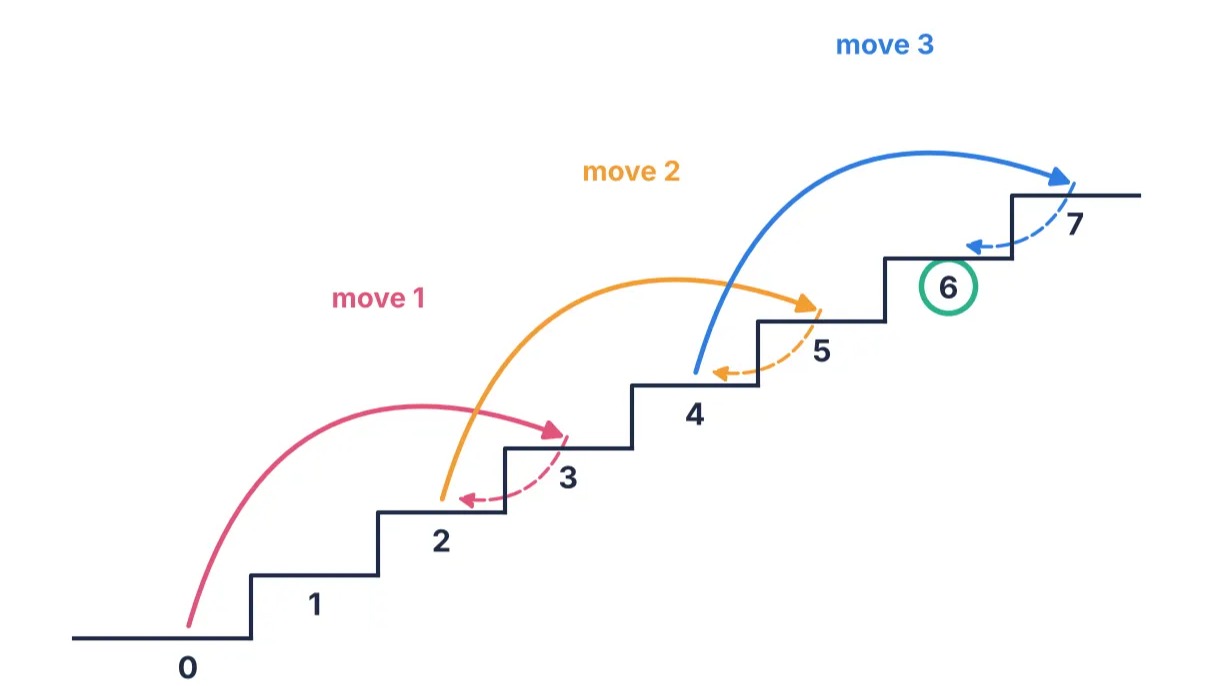
A frog starts on step 0. In every move it jumps 3 steps up and then slides 1 step down. After how many moves will the frog be on step 6?
(A) 2 · (B) 3 · (C) 4 · (D) 5 · (E) 6
Answer: B (3)
Solution: Each move takes the frog 2 steps up in total. After the first move it is on step 2, after the second on step 4, and after the third on step 6.
Another way: Draw the steps on paper and show each jump with an arc. For young children, seeing the frog's path is clearer than any explanation.
Question 3 (Hard)
In the word KANGAROO, how many different letters appear more than once?
(A) 0 · (B) 1 · (C) 2 · (D) 3 · (E) 4
Answer: C (2)
Solution: Only A and O appear twice; every other letter appears once, so the answer is 2. The trap is option E (4), which counts all the repeated letters (A, A, O, O) instead of the different letters.
Math Kangaroo Sample Questions for Grades 3 and 4
Patterns, days of the week, ordering, and simple area and perimeter show up often at this level.
Question 1 (Easy)
Today is Saturday. What day of the week will it be 10 days from today?
(A) Monday · (B) Tuesday · (C) Wednesday · (D) Thursday · (E) Friday
Answer: B (Tuesday)
Solution: 7 days from now is Saturday again. That leaves 3 more days: Sunday, Monday, Tuesday.
Question 2 (Medium)
Sam is standing in a line. He is 4th from the front and 6th from the back. How many children are in the line?
(A) 8 · (B) 9 · (C) 10 · (D) 11 · (E) 12
Answer: B (9)
Solution: There are 3 children in front of Sam and 5 behind him. Counting Sam: 3 + 5 + 1 = 9. The common mistake is adding 4 and 6, which counts Sam twice and gives 10.
Question 3 (Hard)
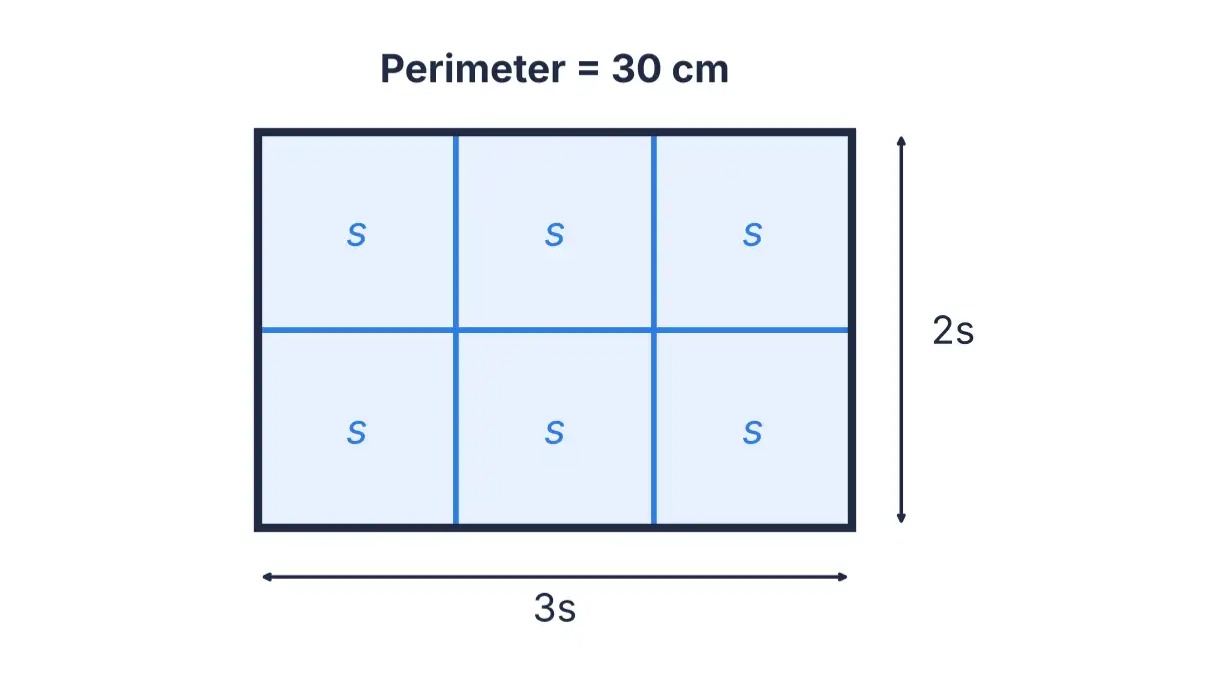
A rectangle is made of 6 equal squares placed in 2 rows of 3. The perimeter of the rectangle is 30 cm. What is the area of the rectangle?
(A) 36 cm² · (B) 45 cm² · (C) 54 cm² · (D) 60 cm² · (E) 90 cm²
Answer: C (54 cm²)
Solution: If each square has side s, the outline of the rectangle is made of 10 square sides (3 + 2 + 3 + 2). So 10s = 30 and each side is 3 cm. Each square has an area of 9, and the whole rectangle 6 × 9 = 54 cm².
Math Kangaroo Sample Questions for Grades 5 and 6
From this level the test has 30 questions, and number properties, systematic counting and angles start to appear.
Question 1 (Easy)
The sum of three consecutive whole numbers is 48. What is the largest of the three numbers?
(A) 15 · (B) 16 · (C) 17 · (D) 18 · (E) 19
Answer: C (17)
Solution: The middle number equals the average of the three: 48 ÷ 3 = 16. So the numbers are 15, 16 and 17, and the largest is 17.
Solution 2 (with algebra): Call the first number n: n + (n+1) + (n+2) = 48, so 3n + 3 = 48, 3n = 45 and n = 15. The three consecutive numbers are 15, 16 and 17.
Question 2 (Medium)
How many two-digit numbers have digits that add up to 5?
(A) 4 · (B) 5 · (C) 6 · (D) 9 · (E) 10
Answer: B (5)
Solution: The tens digit can't be zero, so it runs from 1 to 5 and the ones digit makes up the rest: 14, 23, 32, 41, 50. Listing answers in order is a key Kangaroo skill. The trap is forgetting 50, and also remember that 05 is not a two-digit number, so it doesn't count.
Question 3 (Hard)
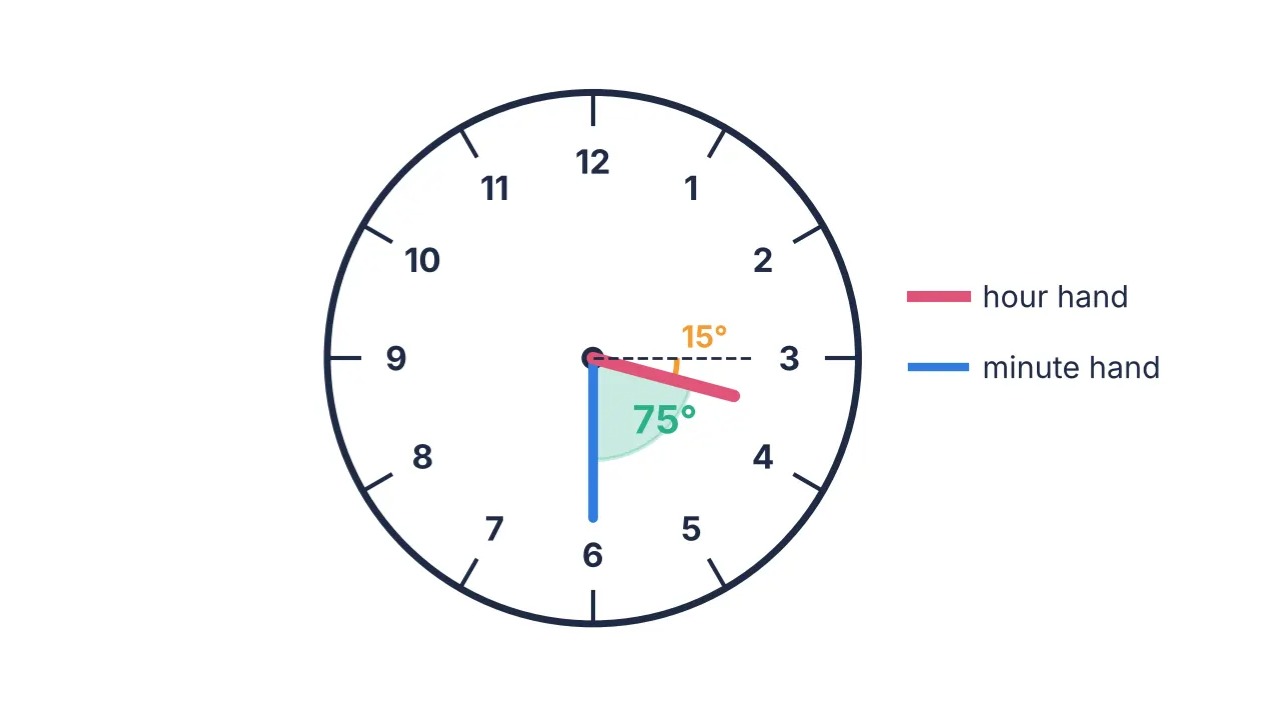
What is the angle between the hour hand and the minute hand of a clock at 3:30?
(A) 60° · (B) 75° · (C) 90° · (D) 95° · (E) 105°
Answer: B (75°)
Solution: Neighbouring numbers on a clock are 30° apart. The minute hand is on 6, but the hour hand is not on 3: it is halfway between 3 and 4, which is 15° past 3. From 3 to 6 is 90°, so the angle is 90° − 15° = 75°. Most children forget that the hour hand moves and choose 90°.
Math Kangaroo Sample Questions for Grades 7 and 8
Percentages, averages and divisibility are common topics at this level.
Question 1 (Easy)
A shirt costs $40. Its price is increased by 25%, and then the new price is decreased by 20%. What is the final price?
(A) $36 · (B) $38 · (C) $40 · (D) $42 · (E) $44
Answer: C ($40)
Solution: After the increase: 40 × 1.25 = $50. After the decrease: 50 × 0.8 = $40. The price is back where it started, because 1.25 × 0.8 = 1. The trap is taking 5% off the original price.
Question 2 (Medium)
The average of five numbers is 12. When one of the numbers is removed, the average of the remaining four numbers is 10. Which number was removed?
(A) 2 · (B) 10 · (C) 12 · (D) 18 · (E) 20
Answer: E (20)
Solution: Remember: average = sum ÷ count, so sum = average × count. The five numbers add up to 5 × 12 = 60 and the four remaining ones to 4 × 10 = 40. The removed number is 60 − 40 = 20. With averages, always start from the sum.
Question 3 (Hard)
How many positive whole numbers less than 100 are divisible by 3 or by 5?
(A) 33 · (B) 45 · (C) 46 · (D) 52 · (E) 53
Answer: C (46)
Solution: Multiples of 3 below 100: 33 numbers (3 to 99). Multiples of 5: 19 numbers (5 to 95). Multiples of 15 were counted twice: 6 numbers (15 to 90). So the answer is 33 + 19 − 6 = 46. Option D (52) is the double-counting trap.
Math Kangaroo Sample Questions for Grades 9 and 10
Algebra, triangle geometry and digit patterns appear often at this level.
Question 1 (Easy)
If x + 1/x = 3, what is the value of x² + 1/x²?
(A) 5 · (B) 6 · (C) 7 · (D) 9 · (E) 11
Answer: C (7)
Solution: Square both sides: x² + 2 + 1/x² = 9. The middle term is 2 because x × 1/x = 1. So x² + 1/x² = 9 − 2 = 7. There's no need to find x; this trick saves a lot of time in Kangaroo.
Question 2 (Medium)
A right triangle has legs of length 6 and 8. What is the radius of the circle inscribed in the triangle?
(A) 1 · (B) 2 · (C) 2.5 · (D) 3 · (E) 4
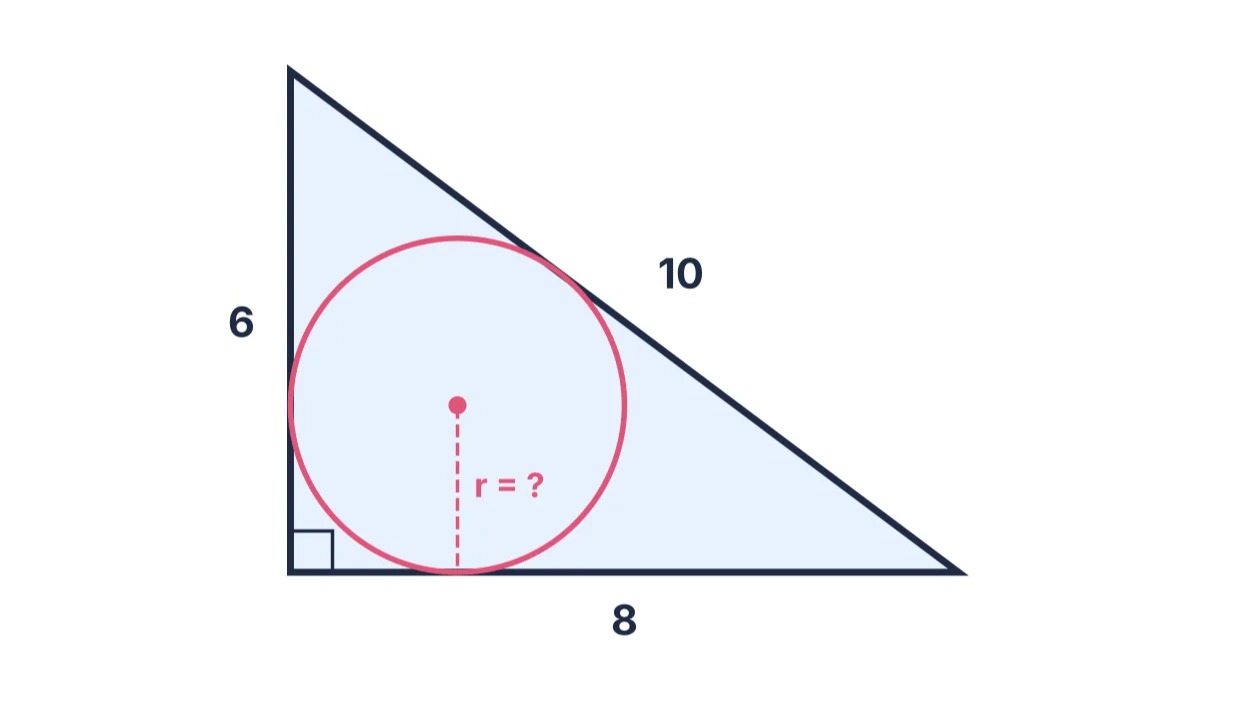
Answer: B (2)
Solution: The hypotenuse is 10 (36 + 64 = 100). The triangle's area is 24 and half its perimeter is 12. The inradius equals area ÷ half-perimeter: 24 ÷ 12 = 2. For right triangles there's a faster way: (6 + 8 − 10) ÷ 2 = 2.
Question 3 (Hard)
What is the last digit of 7²⁰²⁶?
(A) 1 · (B) 3 · (C) 5 · (D) 7 · (E) 9
Answer: E (9)
Solution: Work out the first few powers: 7¹ = 7, 7² = 49, 7³ = 343, 7⁴ = 2401. The last digits go 7, 9, 3, 1 and the pattern repeats every 4 powers. 2026 leaves a remainder of 2 when divided by 4, so 7²⁰²⁶ = (7⁴)⁵⁰⁶ × 7². The last digit of (7⁴)⁵⁰⁶ is 1 and the last digit of 7² is 9, so the answer is 9.
Math Kangaroo Sample Questions for Grades 11 and 12
Logarithms, probability and sequences are common at this level, and reading every condition in the question really matters.
Question 1 (Easy)
Two fair six-sided dice are rolled. What is the probability that the sum of the two numbers is 7?
(A) 1/12 · (B) 1/9 · (C) 1/6 · (D) 7/36 · (E) 1/3
Answer: C (1/6)
Solution: There are 6 × 6 = 36 outcomes in total. The ones that add up to 7 are (1,6), (2,5), (3,4), (4,3), (5,2), (6,1): 6 outcomes. The probability is 6 ÷ 36 = 1/6.
Question 2 (Medium)
What value of x satisfies log₂(x) + log₂(x − 2) = 3?
(A) −2 · (B) 2 · (C) 4 · (D) −2 and 4 · (E) 8
Answer: C (4)
Solution: The sum of two logarithms is the logarithm of the product: log₂(x(x − 2)) = 3, so x(x − 2) = 8. The equation x² − 2x − 8 = 0 has two roots, 4 and −2. But the logarithm of a negative number isn't defined, so only x = 4 works. Option D is the trap for anyone who doesn't check the domain.
Question 3 (Hard)
What is the value of 1/(1·2) + 1/(2·3) + 1/(3·4) + … + 1/(99·100)?
(A) 1/100 · (B) 1/2 · (C) 99/100 · (D) 1 · (E) 100/99
Answer: C (99/100)
Solution: Each term can be written as a difference: 1/(n(n+1)) = 1/n − 1/(n+1). Almost every term then cancels out, leaving only 1 − 1/100 = 99/100. This is called a telescoping sum.

Preparing for Math Kangaroo with an Online Tutor
As you've seen, Kangaroo tests careful thinking more than formulas: ignoring extra information, listing cases in order, drawing a picture and spotting trap answers. These skills grow much faster with regular practice and good feedback.
At Darsoon, online math tutors prepare students of every grade for Math Kangaroo, fully online and at times that work for families in Canada and the US. You can book a free intro session to meet a tutor and see whether their approach suits your child. For a week-by-week schedule, see our 8-week Math Kangaroo prep plan.


