
10 Fun Multiplication Games for Kids to Learn Times Tables Faster
If your child groans at the words "times tables", you're not alone: drilling multiplication with worksheets wears many kids out. Here are 10 simple games with cards, dice, a ball and LEGO, most needing nothing special, that you can try at home tonight.
Written by: Mahroo Mahdavi
Number of Views: 1
Reading time: 5 min
Why Do Games Work Better for Learning Times Tables?
When kids play, they don't just memorize. They see numbers, touch them and talk about them. That is what makes multiplication mean something, instead of being a list of numbers to recite.
Less stress: mistakes are part of any game, so kids aren't afraid to try.
Repetition without boredom: a good game can be played again and again, which is exactly the repetition memory needs.
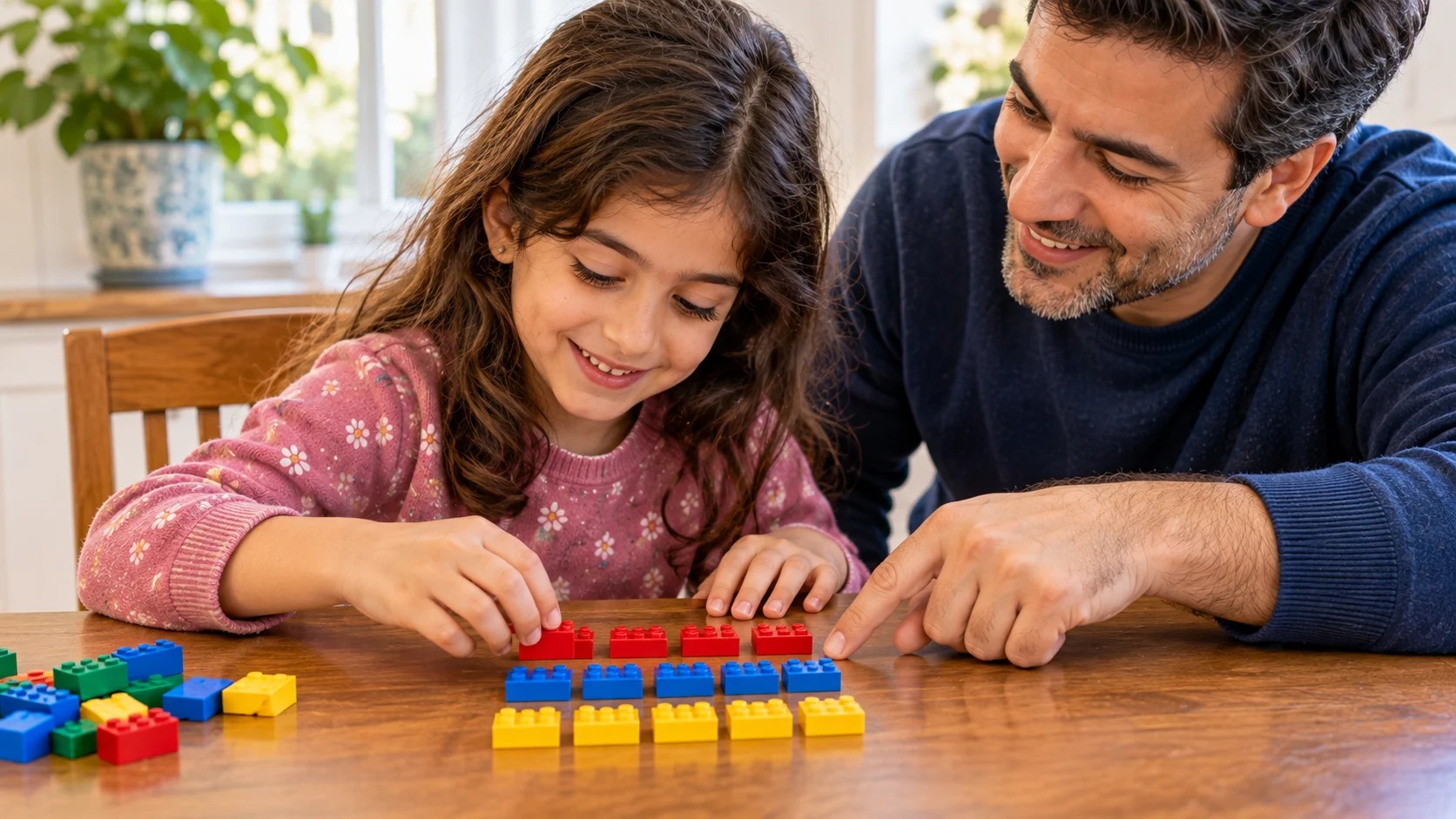
Understanding, not just answers: when a child builds three groups of four LEGO bricks, they see what 3 × 4 really means.
Family time: games let parents sit with their child without playing the strict teacher.
10 Multiplication Games for Kids
1. Multiplication War with Playing Cards
Use a regular deck with the face cards removed. Each player flips two cards and multiplies them. Whoever has the bigger product takes the cards. It builds speed, and kids usually ask for round after round.
2. Multiplication Dice
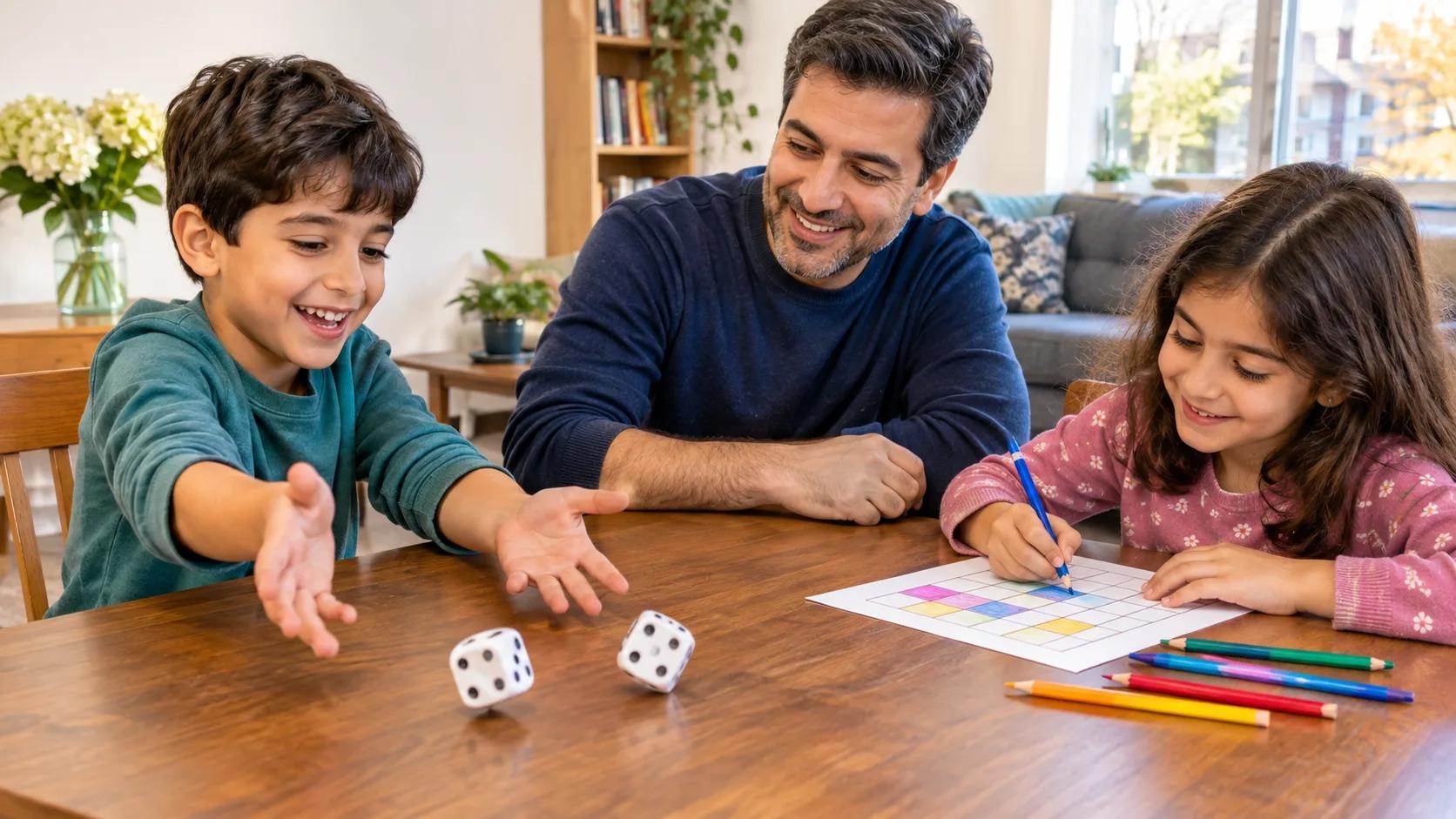
Roll two dice and multiply the numbers. Draw a 6 × 6 grid on paper and color in each correct answer. The first player to color a full row wins. For older kids, use 10- or 12-sided dice.
3. Times Tables Bingo
Give each player a bingo card filled with products (12, 24, 36 and so on). You call out a question, such as "6 times 4", and the child marks the answer on their card. It also works well at family gatherings and parties.
4. Multiplication Hopscotch
Use tape on the floor or chalk outside to draw squares with the multiples of one number, for example 3, 6, 9, 12. Each time the child jumps, they say the next number out loud. Moving helps energetic kids focus.
5. Multiplication Catch
Toss a ball to your child and ask a question at the same time. They answer before throwing it back, then it's their turn to quiz you. It's fast, and asking you questions lets them play the teacher for a change.
6. Skip-Counting Songs
Sing skip counting (4, 8, 12, 16…) to the tune of a familiar nursery rhyme. Even better, make up the song together; kids remember what they helped create. If your child learns in English at school, you can make a Persian version too and practice Persian numbers along the way.
7. Building Multiplication with LEGO and Household Objects
Ask your child to "build" 3 × 5 with LEGO, buttons or dried beans: three rows of five. Then turn it around into five rows of three. They see for themselves that 3 × 5 and 5 × 3 both make 15. This is the best starting point for kids who don't yet understand what multiplication is.
8. The 9 Times Table Finger Trick
Hold up all ten fingers. For 9 × 4, fold down the fourth finger from the left. Three fingers remain on the left (the tens) and six on the right (the ones): 36. Kids love this trick like a magic show and often teach it to their friends.
9. Memory Match
Write questions (7 × 8) on half the cards and answers (56) on the other half. Lay them face down. Each player turns over two cards and keeps them if the question and answer match. Start with one or two tables and add cards gradually.
10. Multiplication in Everyday Life
Ask real-world questions: "If each carton has 6 eggs, how many eggs are in three cartons?" Or on the way to school: "Four cars, four wheels each. How many wheels?" These need no materials and show kids that multiplication is actually useful.
When Games at Home Aren't Enough
Some kids take off after a few simple games; others need more structured help. Their addition skills may be shaky, they may be anxious about math, or, like many children of Iranian families abroad, they learn times tables in English at school and get confused when parents explain them in Persian at home.
Darsoon is a trusted online tutoring platform for Persian speakers around the world, with math classes for every age. You choose a tutor based on your child's age, level and schedule, and get one-on-one online lessons wherever you live. A good tutor can bring these same games into the lesson and pinpoint exactly where your child gets stuck.
What is Darsoon's free intro session? Before regular lessons start, you can book a free session with a tutor. The online math tutor gets to know your child, sees where they are and talks with you about how they would work together. You get to see whether your child feels comfortable with that tutor, with no commitment to continue. Our complete guide to online math classes for kids and teens can help you choose.
Which Game Is Right for Your Child?
You don't need to try every game. Use this guide to pick two or three to start with, based on your child's age and level.
LEGO and household objects: Suggested age: 6 to 8 · What you need: LEGO, buttons or beans · Best for: Understanding multiplication
Skip-counting songs: Suggested age: 6 to 8 · What you need: Nothing · Best for: Skip counting and memory
Multiplication hopscotch: Suggested age: 6 to 9 · What you need: Tape or chalk · Best for: Learning through movement
Multiplication catch: Suggested age: 7 to 10 · What you need: A ball · Best for: Answering quickly
Multiplication dice: Suggested age: 7 to 10 · What you need: Two dice, paper · Best for: Practicing tables 1 to 6
Times tables bingo: Suggested age: 7 to 10 · What you need: Homemade bingo cards · Best for: Group review
Memory match: Suggested age: 7 to 10 · What you need: Homemade cards · Best for: Locking in answers
Multiplication war: Suggested age: 8 to 11 · What you need: A deck of playing cards · Best for: Calculation speed
9 times table finger trick: Suggested age: 8 to 11 · What you need: Nothing · Best for: The 9 times table
Everyday multiplication: Suggested age: All ages · What you need: Nothing · Best for: Using multiplication in word problems
Tips to Make These Games Actually Work
Start with the easy tables: first 2, 5 and 10, then 3 and 4, and finally 6 to 9. Early small wins keep kids motivated.
Show them the job is half done: once they know 3 × 7 is the same as 7 × 3, they only need to learn about half of the 100 facts.
Keep it short and regular: 10 to 15 minutes a day beats one hour-long session on the weekend.
Praise effort, not just right answers: instead of "you're so smart", try "see how much faster you got with practice?"
Match the language of school: if your child goes to school in Canada or the US, it's fine to play in English sometimes and in Persian other times. They practice math and Persian at once.
When Should You Be More Concerned?
If, after a few weeks of regular practice, your child still counts simple facts on their fingers, avoids math homework or their grades are slipping, the issue may be bigger than times tables. Our article 7 clear signs your child needs math help walks through these signs so you know when it's time to bring in a tutor.
Conclusion
Learning times tables doesn't have to end in tears. With a deck of cards, two dice or a handful of LEGO, multiplication can become part of family game time. Pick two or three games that fit your child's age, play a few minutes every day and celebrate their progress.
If you feel your child needs more support, Darsoon's online math tutors can work with these same fun methods at your child's level. Book a free intro session to start and see which tutor is the best fit for your child.

