
Ontario Report Card Explained: Levels 1–4 and Learning Skills for Parents
The first time you open an Ontario report card, you see things like Level 3, a B+, or the letters E and G, and it is hard to tell whether to celebrate or worry. This guide walks through each part of the report card and what you can do after reading it.
Written by: Mahroo Mahdavi
Number of Views: 23
Reading time: 5 min
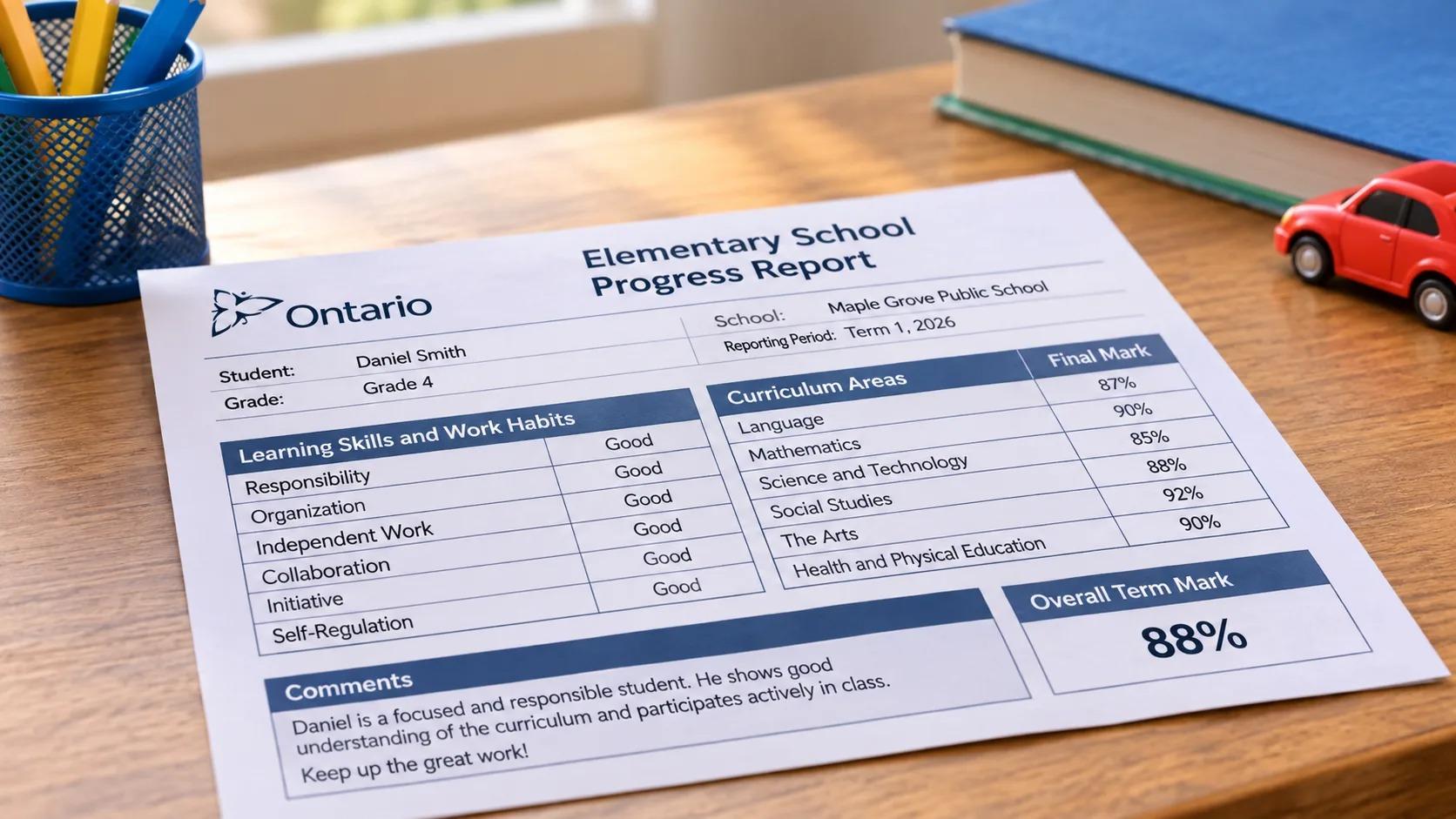
How often do Ontario report cards come home?
Ontario report cards follow simple logic: every public school in the province follows one shared policy called Growing Success. Students in Grades 1 to 8 get three reports during the school year:
Fall Progress Report: When: October 20 to November 20 · What it includes: No marks; progress in each subject is shown as Very well, Well or With difficulty
First report card: When: January 20 to February 20 · What it includes: A mark for each subject, Learning Skills and teacher comments
Final report card: When: June · What it includes: The same sections, for the whole year
In high school (Grades 9 to 12), semestered schools send two report cards per semester, and non-semestered schools send three a year. Each school board sets the exact dates.
If you see With difficulty next to a subject on the Fall Progress Report, don't read it as a fail. It is an early warning, and there are still a few months before the first report card to catch up.
What do Levels 1 to 4 mean on an Ontario report card?
Ontario teachers compare a child's work with the provincial curriculum expectations, not with their classmates. That evaluation uses four levels and looks at four skills: knowledge and understanding, thinking, communication, and application.
In Grades 1 to 6 the level appears as a letter grade, and in Grades 7 to 12 as a percentage:
Level 4: Meaning: Above the standard; shows the skills with a high degree of effectiveness · Letter grade (Grades 1–6): A · Percentage (Grades 7–12): 80 to 100
Level 3: Meaning: The provincial standard; shows the skills with considerable effectiveness · Letter grade (Grades 1–6): B · Percentage (Grades 7–12): 70 to 79
Level 2: Meaning: Approaching the standard; some effectiveness · Letter grade (Grades 1–6): C · Percentage (Grades 7–12): 60 to 69
Level 1: Meaning: Well below the standard; limited effectiveness · Letter grade (Grades 1–6): D · Percentage (Grades 7–12): 50 to 59
A plus or minus sign shows where a child sits within that level. A B+, for example, means the top of Level 3, close to Level 4.
Why is Level 3 a good mark?
Many parents who went to school outside Canada see a B as a so-so grade and start to worry. In Ontario, though, Level 3 is the standard the Ministry of Education has set for every student. A child at Level 3 is ready for the next grade or course.
So if your child got a B, they are right where they should be. Real concern starts at Level 2 and below. In high school, a student needs at least 50 percent to earn the credit for a course.
What do the R and I codes mean?
Sometimes you'll see a letter instead of a mark:
R: The child has not yet reached the knowledge and skills needed for the subject and needs serious extra support. R means below Level 1, or under 50 percent.
I: The teacher didn't have enough information to give a mark (Grades 1 to 10). This usually happens when a child has just changed schools or was ill for a long time.
For families who have just arrived in Canada, an I on the first report card is nothing unusual. Next to some subjects there are also ESL/ELD and IEP boxes. If they are checked, the expectations for that subject have been adjusted for your child or aligned with an English-language or special education program. If you are still choosing a school, our guide to French Immersion or an English school in Ontario may help.

What are Learning Skills on the report card?
The Learning Skills and Work Habits section shows how a child learns, not how much they have learned. These six skills are reported on every report card from Grade 1 to 12:
Responsibility: What the teacher looks at: Handing work in on time and owning their behaviour
Organization: What the teacher looks at: Planning tasks and managing time and materials
Independent Work: What the teacher looks at: Working without constant reminders and following instructions
Collaboration: What the teacher looks at: Group work, respecting others' ideas and doing a fair share
Initiative: What the teacher looks at: Asking questions, curiosity and trying new approaches
Self-Regulation: What the teacher looks at: Setting goals, managing emotions and sticking with hard tasks
What do E, G, S and N mean?
Each skill is rated with one of four letters:
E (Excellent): Teachers usually describe this as showing the skill all the time, with no reminders.
G (Good): Most of the time, with few reminders.
S (Satisfactory): Some of the time, with several reminders.
N (Needs Improvement): Rarely, and with constant reminders.
Do Learning Skills affect the marks?
Under Ministry policy, Learning Skills are evaluated separately from subject marks as far as possible. Homework, for example, does not count toward the mark, but if a child keeps handing it in late or not at all, it shows up in this section. From Grade 7 on, late work can also cost marks.
Don't overlook this section. The subject mark shows where a child is right now; Learning Skills often show why.
What should you do after reading the report card?
Read the teacher's comments first. The Strengths/Next Steps for Improvement section tells you what your child does well and what comes next. It is often more useful than the mark itself.
Read marks and Learning Skills together. If math is at Level 2 and Organization is an S, the problem may not be understanding the material; your child may be struggling to plan and hand in work.
Don't compare it with the system you grew up with. A B is not a weak mark here. The better question is whether your child has improved since the last report card.
Talk with your child. Ask what their best work this term was and what they'd like to get better at. The form at the bottom of the report card has space for comments from both of you.
If you have questions, meet the teacher. On the same form you can check "I would like to discuss this report card." Ask exactly which part of the subject is hard and how you can help at home.
For a weak subject, make a clear plan. If a subject stays at Level 2 or below for several report cards in a row, don't wait for it to fix itself. A few focused sessions on that exact area usually make a clear difference.
Conclusion
An Ontario report card tells you three things: where your child stands in each subject against the standard (the level or mark), how they learn (Learning Skills), and what the teacher suggests next. Level 3 means your child is on the right track. If a subject is lower, the sooner you know exactly where the gap is, the easier it is to close.
If your child’s report card shows that they need extra support in a subject such as math, Darsoon is here to help.
At Darsoon, you can find a Persian-speaking online math tutor who matches your child’s age and skill level and can accommodate your local time zone.
The Darsoon online learning platform also offers experienced and professional teachers for other subjects, including science, physics, chemistry, French, English, and more. Many of our teachers are also familiar with the Canadian education system.
A free introductory meeting is a great opportunity to review your child’s report card with the teacher, discuss areas where they may need additional support, and then decide on the next steps.


