
Persian Learning Games for Kids: 20 Fun Games by Age
Want your child to learn Persian (Farsi) without pressure? Here are 20 simple games you can play at home, grouped by age from preschool to the teen years, plus practical tips to make them actually work.
Written by: Mahroo Mahdavi
Number of Views: 12
Reading time: 5 min

If you live in Canada or the US, this scene probably sounds familiar: you speak Persian (Farsi) to your child, and they answer in English. School, friends and cartoons all happen in another language, and Persian slowly shrinks to a few phrases used at home.
The good news is that Persian doesn't have to feel like a boring lesson. Learning Persian through games helps kids pick up words, build sentences and gradually try reading and writing, without pressure. When children laugh and compete, they remember the language with good feelings attached.
Below are 20 simple, low-cost games, grouped by age. Most use things you already have at home and take 10 to 15 minutes. The ages are approximate; if your child is just starting Persian, begin with games from a younger group.
Persian games for ages 3 to 5
At this age the goal is lots of listening and saying simple words. Reading and writing can wait.
1. The mystery bag
Put a few familiar objects, such as a spoon, a ball, an apple and a sock, into a cloth bag. Your child feels an object, guesses what it is, pulls it out and says its Persian name. It's a great way to build everyday vocabulary.
2. "The commander says"
This is the Persian take on Simon Says: "Farmandeh migeh, put your hand on your head!" Your child only follows the command if it starts with "the commander says." Body parts and simple verbs like jump, sit and spin are learned without memorizing.
3. Find something red!
Ask your child to find something red, yellow or blue around the house, then let them give you a turn. For variety, add shapes (round, square) and sizes (big, small).
4. Rhymes with movement
Sing Persian nursery rhymes, such as the classic "Atal Matal Tutuleh," with hand and body movements. The rhythm and repetition help your child absorb the sounds and melody of Persian.
5. Play shop
Set up a little shop with toy fruit. Your child becomes the shopkeeper or the customer and practices sentences like "Salaam, I'd like an apple." Pretend play is one of the best ways to build sentences naturally.
Persian learning games for ages 6 to 8
Most children start the alphabet around this age, so the games move toward letters and sounds. For more on the alphabet stage itself, read our guide to the best methods for teaching the Persian alphabet to bilingual children.
6. Letter hunt
Pick a letter, for example "ب" (b), and give yourselves one minute to find everything at home that starts with it: pillow (balesh), plate (boshghab), ice cream (bastani). You can write the letter on sticky notes and attach them to the objects.
7. Letter and picture memory
Make cards with letters on half of them and pictures on the rest ("س" and an apple, sib). Lay them face down and let your child find the matching pairs. It trains memory and makes letter shapes stick.
8. Letters on the back
Trace a letter or a short word on your child's back with your finger and let them guess it, then switch places. The game connects letter shapes, and the right-to-left direction of Persian writing, with the sense of touch.
9. Alphabet hopscotch
Draw a few squares on the floor with chalk or tape and write a letter in each. Every time your child hops onto a square, they say that letter's sound or a word that starts with it. Perfect for high-energy kids.
10. Three-card story
Draw three random picture cards, such as a cat, a car and rain. Your child has to tell a short Persian story that uses all three. It builds sentence-making, creativity and the confidence to speak.
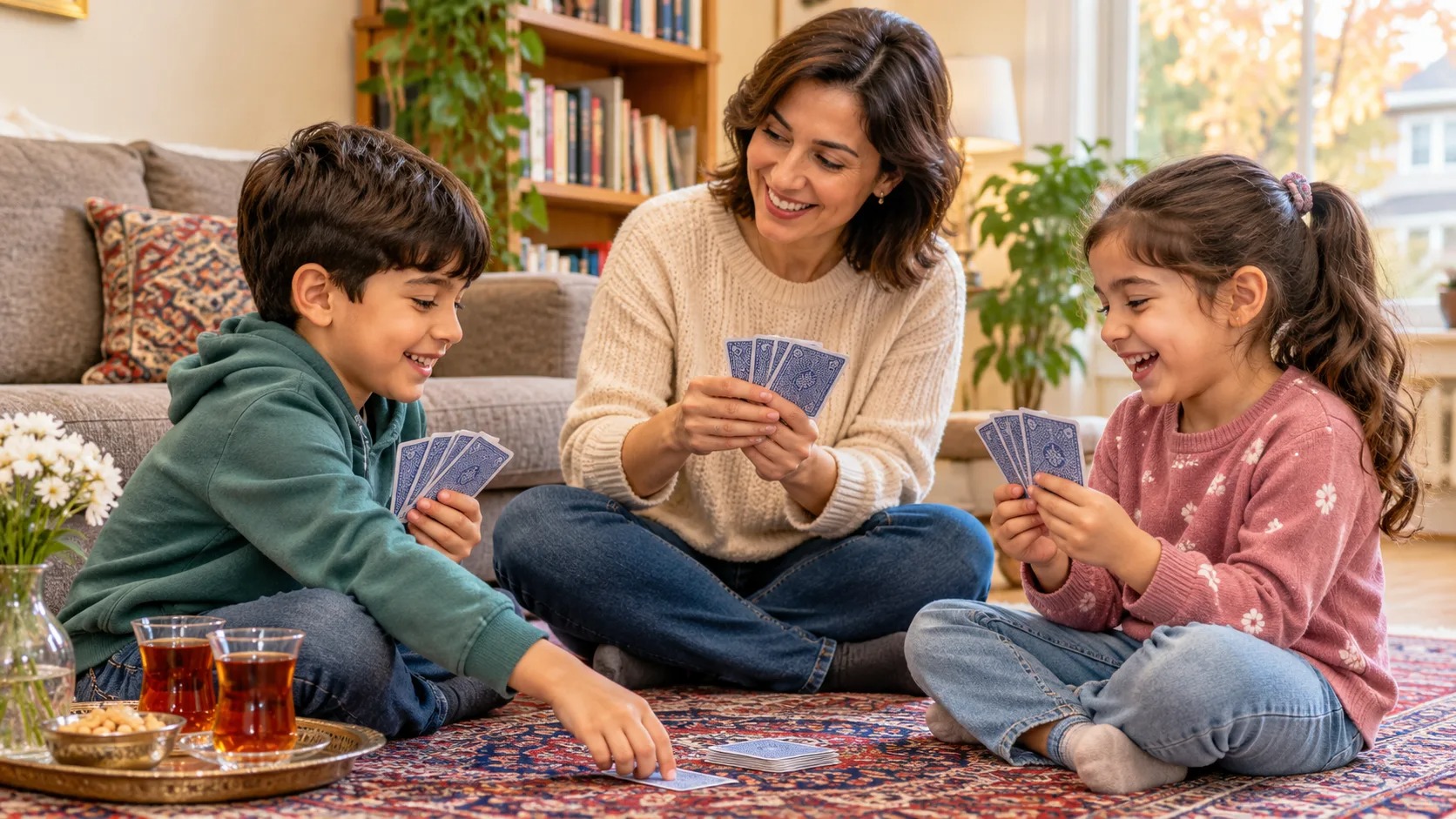
Persian games for ages 9 to 12
Kids this age love competition and challenge, so games can target reading, spelling and richer vocabulary.
11. Esm, Famil (Name, Family, City, Animal)
This is the nostalgic game many Iranian parents grew up with. A letter is chosen and everyone quickly writes a word for each column: first name, last name, city, animal, food, object. Spelling, writing speed and vocabulary all get practice at once.
12. Scrambled words
Write the letters of a word on small slips of paper and mix them up (ت، ک، ا، ب → کتاب, "book"). Your child has to rebuild the word. To make it harder, make several short words from the letters of one long word.
13. Twenty questions
One person thinks of something and the others guess with up to 20 yes/no questions: "Is it alive?" "Can you find it in the kitchen?" Kids practice asking questions and sorting ideas into categories in Persian.
14. Proverb charades
Act out a simple Persian proverb without speaking, such as "the moon won't stay behind the clouds" (the truth always comes out), and let others guess. Then talk about what it means. It's a fun way into Persian culture and figurative language.
15. Persian treasure hunt
Write a few short clues and hide them around the house, for example "Go where the food stays cold." Each clue leads to the next until your child finds the prize. Few games motivate reading as much.
Persian games for teens (13 and up)
Teens avoid anything that feels childish. It works better when the game connects to their own interests, like music, movies and social media.
16. Moshaereh (poetry duel)
One person recites a line of poetry, and the next has to recite a line that starts with the last letter of the previous one. To start, you can use Persian song lyrics instead of classical poetry. It strengthens memory and familiarity with Persian literature.
17. A Persian podcast or vlog
Ask your teen to make a two-minute video or podcast in Persian about something they love, such as reviewing a video game. Sending it to their grandparents usually adds extra motivation.
18. Forbidden words
Each card has a main word and a few banned words, for example "school" without saying teacher, class or lesson. The player has to explain the word to a teammate. It practices explaining and finding alternative words.
19. Persian subtitles for a clip
Pick a short English clip or a meme your teen likes and have them write Persian subtitles for it. They practice writing and notice how expressions differ between the two languages.
20. Persian crosswords and riddles
Solve simple Persian crosswords or riddles as a timed competition. Later, your teen can write their own riddles for you, which doubles the practice.

A few tips to make the games actually work
Short and regular: 10 to 15 minutes of play a day works better than an hour on the weekend.
Don't penalize mistakes: repeat the correct form casually and keep the game going.
Have "Persian time": during the game, everyone, adults included, speaks only Persian.
Lose sometimes: winning keeps your child motivated for the next round.
Connect games to daily life: reuse new words at dinner or in the car.
Bring family in: turn a video call with grandparents into a round of twenty questions or Moshaereh.
Conclusion
Teaching Persian through games is one of the simplest ways to keep a heritage language alive at home. You don't need to try all 20; pick two or three that suit your child's age and interests and stick with them for a few weeks.
If you feel your child needs a more structured plan, for example to learn the alphabet or strengthen reading and writing, a Persian tutor who has worked with kids growing up abroad can use these same games in a targeted, step-by-step way.
On Darsoon, you can find a Persian tutor who fits your child's age and level, and book a free intro session first to see whether the teacher's approach suits your child.
